
The definition of the workplace has undergone a permanent structural transformation. It is no longer defined by a physical coordinate or a specific corporate real estate asset. Instead, the modern workplace exists within a highly integrated, cloud-native stack of software applications, automated frameworks, and intelligent hardware. As companies navigate a landscape defined by distributed operations, macro-economic shifts, and rapid technical advancements, the tools employees use daily dictate organizational survival.
The trajectory of workplace technology focuses on removing cognitive friction, automating administrative overhead, and bridging the collaborative divide between physical and digital spaces. Rather than merely acting as static utilities, next-generation workplace tools are shifting into proactive agents that reshape how human capital is deployed, optimized, and sustained.
Autonomous Orchestration: The Next Generation of Workflow Automation
For years, digital transformation in the enterprise focused on basic automation—setting up simple rules to move a document from one folder to another or trigger an email notification when a task changed status. While helpful, these systems remained rigid, requiring constant human oversight and manual troubleshooting whenever a variable deviated from pre-defined paths.
The future of workplace efficiency relies on autonomous orchestration platforms. These systems do not just execute explicit commands; they possess contextual awareness. By observing enterprise data streams, communication logs, and historical project lifecycles, these tools identify operational bottlenecks before they manifest and dynamically reallocate resources.
For example, when a software-as-a-service enterprise launches a major product update, an autonomous orchestration system can automatically evaluate customer support queues, detect an influx of specialized technical inquiries, cross-reference employee availability schedules, and automatically assign targeted training modules to available tier-one support representatives. This entire operational pivot occurs without requiring a middle manager to manually parse data or assign tasks, allowing human leadership to focus on long-term strategy rather than tactical fire-fighting.
Spatial Computing and Unified Hybrid Collaboration
The hybrid work model has introduced significant collaborative fragmentation. While remote work offers unprecedented geographical flexibility, it frequently diminishes the spontaneous innovation, mentorship, and psychological cohesion that naturally occurs within physical corporate headquarters. Traditional video conferencing tools often fall short, inducing cognitive fatigue and failing to replicate the nuanced dynamics of real-time human interaction.
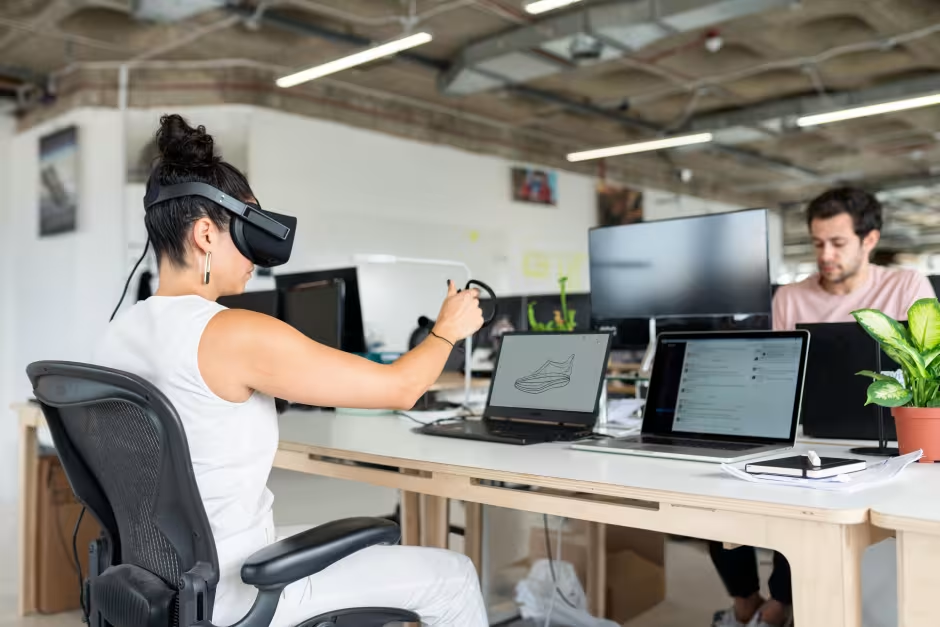
Spatial computing platforms and persistent three-dimensional workspaces solve this challenge. By utilizing high-fidelity mixed reality hardware and spatial audio algorithms, distributed teams can gather around a single digital object, such as a physical product prototype, a complex architectural blueprint, or a massive structural data model.
In these environments, proximity dictates volume; turning to speak to a colleague sitting next to your digital avatar creates a natural, conversational cadence. This technology transforms remote collaboration from a passive viewing experience into an active, shared environment, dramatically accelerating product development cycles and reducing the need for costly corporate travel.
Contextual Knowledge Graph Engines: Eradicating Internal Search Friction
One of the largest hidden drains on modern enterprise productivity is information fragmentation. As a company expands, its institutional knowledge becomes scattered across separate platforms: legal contracts live in a document management system, client records sit inside a customer relationship management framework, product documentation resides in wiki repositories, and critical strategic decisions are buried within thousands of private chat logs and email threads.
Employees waste hours each week attempting to locate specific, historical data points required to execute their current tasks. The future workplace eliminates this friction through the deployment of enterprise-wide contextual knowledge graph engines.
-
Semantic Data Integration: These engines do not merely match keywords; they map the structural relationships between distinct corporate entities, individuals, projects, and clients.
-
Instant Contextual Retrieval: When an employee queries the system regarding a past project, the engine surfaces the original contract terms, the exact developers who wrote the underlying code, the code repositories used, and the subsequent client feedback loops, compiling an exhaustive brief in seconds.
-
Proactive Knowledge Surfacing: If an executive begins drafting a proposal for a new market entry, the system detects the strategic intent and automatically surfaces relevant past failures, regional compliance documentation, and competitive intelligence reports generated by completely different departments years prior.
Advanced Workforce Analytics and Cognitive Load Management
As work speeds up and communication channels multiply, employee burnout represents a major risk to corporate stability. The continuous influx of instant messages, urgent emails, and back-to-back virtual meetings can overwhelm workers, leading to cognitive fragmentation and a steep decline in deep, focused execution.
To combat this systemic operational risk, next-generation workplace tools incorporate sophisticated workforce analytics and cognitive load management capabilities. These systems operate with strict adherence to data privacy standards, focusing on macro-level behavioral patterns rather than intrusive individual surveillance.
By analyzing anonymized metadata across enterprise communication tools, calendar invites, and task completion velocities, these platforms measure the cognitive health of an organization. If the system detects that a specific department is spending eighty percent of its working hours in internal meetings while experiencing a sharp spike in after-hours communication, it alerts leadership to the structural imbalance.
Furthermore, these tools feature intelligent notification-filtering systems that automatically silences non-urgent alerts during blocks of designated focus time, actively defending employees’ mental bandwidth and allowing them to achieve deep, uninterrupted creative focus.
Hardware Evolution: Intelligent Edge Stations and Smart Office Ecosystems
The transformation of workplace technology tools extends beyond software applications into physical workspace hardware. For employees who split time between a home office and a corporate campus, the physical desktop environment is becoming completely automated.
Intelligent edge docking stations now serve as centralized hardware hubs that automatically configure a worker’s digital environment based on their identity and scheduled tasks. When a worker approaches a hot-desk or a home workspace, the system automatically adjusts monitor heights, ambient lighting arrays, and acoustic noise-cancellation profiles to match their physiological preferences.
Simultaneously, within corporate headquarters, smart meeting rooms utilize multi-directional camera arrays and voice-separation algorithms to automatically generate structured meeting summaries, assign action items to specific individuals within project management systems, and update corporate roadmaps in real time based on verbal commitments made during the session.
Securing the Perimeterless Enterprise: Continuous Trust Architectures
The shift away from traditional, centralized office spaces has permanently broken legacy network security frameworks. When employees access sensitive corporate infrastructure from home networks, public access points, and various mobile devices, the traditional concept of securing a corporate perimeter becomes obsolete.
The future workplace relies on continuous trust architectures. Rather than granting permanent access once an employee logs in with a password and multi-factor authentication token, these next-generation security tools continuously evaluate the risk profile of every digital transaction.
The system assesses contextual data points, including device health, geographical location patterns, typing biometrics, and the sensitivity of the specific database being accessed. If an employee attempts to download an unusually large volume of proprietary source code from an unfamiliar location at an unusual hour, the system instantly restricts access, flags the anomaly for security teams, and challenges the user with contextual authentication protocols. This absolute security layer operates seamlessly in the background, protecting corporate intellectual property without introducing burdensome friction into the daily employee experience.
Frequently Asked Questions
How do autonomous orchestration tools handle unexpected operational changes without breaking down
Unlike legacy automated systems that rely on rigid, fixed logic paths, autonomous orchestration platforms utilize probabilistic frameworks and real-time feedback loops. When an unexpected variable occurs—such as a critical vendor missing a delivery deadline—the tool evaluates alternative operational scenarios based on historical data, assesses available resource pools, and calculates the path of least disruption. It then presents these validated options to human supervisors along with calculated risk scores, allowing for rapid, informed decision-making.
What measures do contextual knowledge graph engines use to protect sensitive internal data access
Knowledge graph engines apply strict, granular role-based access control directly to the semantic layer of the enterprise data network. The system inherits the underlying permission architecture of all connected applications. If an employee does not possess explicit authorization to view sensitive executive compensation details within the core human resources platform, the knowledge graph automatically filters those specific data nodes out of their search results and contextual briefs, ensuring data privacy is never compromised.
In what ways do spatial computing environments reduce the cognitive fatigue associated with video conferencing
Video conferencing forces the human brain to continuously stare at a grid of flat, unnatural faces while processing delayed audio cues, which creates intense cognitive strain. Spatial computing environments eliminate this by utilizing true three-dimensional depth and spatial audio processing. When a colleague speaks from your left side in a virtual space, your brain registers the sound naturally from that direction. This mimics real-world physical dynamics, allowing for natural eye-contact patterns and subconscious spatial awareness, which dramatically lowers mental exhaustion.
How can workforce analytics platforms measure employee burnout risks without invading personal privacy
Modern workforce analytics frameworks focus entirely on structural metadata rather than reading individual message content or tracking precise keystrokes. They measure macro-level indicators such as the total volume of communication sent outside standard working hours, the average duration of uninterrupted focus blocks, and the ratio of meeting times to execution times across entire departments. This anonymized approach provides leadership with actionable operational health data while maintaining complete individual privacy.
What infrastructural requirements must a business meet before deploying a continuous trust architecture
Transitioning to a continuous trust framework requires an organization to centralize its identity management infrastructure, deploy unified endpoint management solutions across all company devices, and implement a robust logging mechanism for all internal network traffic. The enterprise must move away from isolated data siloed within specific departments and establish a standardized API-driven data ecosystem that allows security engines to analyze contextual signals in real time across the entire technology stack.
How do smart meeting rooms accurately assign action items to specific individuals during a chaotic discussion
Smart office spaces deploy advanced voice-print identification systems and natural language processing models. Before a meeting begins, the system identifies the unique acoustic profile of each participant based on their enterprise identity. During the discussion, the linguistic model analyzes the context of the conversation, looking for explicit action verbs, deadlines, and ownership statements. By matching the identified speaker’s voice with these context structures, the platform accurately maps who committed to delivering a specific asset by a certain date.